Search is no longer what it used to be. A few years ago, digital marketers only focused on ranking websites on traditional search engines like Google Search or Bing. Today, the search landscape has evolved dramatically. Users are no longer just clicking on blue links — they are asking questions and receiving direct answers from AI-powered systems such as ChatGPT, Perplexity AI, and Google Gemini. So we can learn here the core differences between SEO vs AEO vs GEO.
This shift has introduced new optimization strategies beyond traditional Search Engine Optimization (SEO). Two emerging concepts are Answer Engine Optimization (AEO) and Generative Engine Optimization (GEO). Businesses, marketers, and content creators must understand these new approaches to stay visible in the future of search.
This article explains the difference between SEO, AEO, and GEO, how they work, and why they will shape the future of digital visibility.
⸻
Understanding SEO (Search Engine Optimization)
Search Engine Optimization (SEO) is the process of optimizing a website to rank higher in search engine results pages (SERPs). The main goal of SEO is to improve a website’s visibility when users search for specific keywords on platforms like Google Search.
SEO has been the backbone of digital marketing for over two decades. When someone searches for a product, service, or piece of information, search engines analyze thousands of web pages and display the most relevant ones.
Key Components of SEO
- Keyword Research
Identifying the search terms people use when looking for information online. - On-Page SEO
Optimizing website content, headings, images, and meta descriptions. - Technical SEO
Improving site speed, mobile usability, and website structure. - Backlinks
Getting other websites to link to your content to build authority. - User Experience
Ensuring visitors can easily navigate and interact with your website.
SEO focuses primarily on ranking pages in search engines so users can click and visit the website.However, the problem is that search behavior is changing rapidly.Many users no longer want to browse multiple websites to find information. They want instant answers.That’s where AEO enters the picture.
⸻
What is AEO (Answer Engine Optimization)?
Answer Engine Optimization (AEO) focuses on optimizing content so that it can be directly used as an answer by AI systems and voice assistants.
Instead of only ranking on search engines, AEO aims to help your content become the actual answer displayed to users.
Modern AI platforms such as ChatGPT, Google Gemini, and Perplexity AI analyze information across the internet and provide summarised responses to user queries.
For example:
A user might ask:
“What is the difference between SEO and AEO?”
Instead of showing ten links like traditional search engines, AI systems generate a direct explanation.
If your content is structured properly, these AI systems may use your website as a source for their answer.
Key Elements of AEO
- Question-Based Content
Content should answer common questions clearly. - Structured Information
Using headings, bullet points, and concise explanations. - Featured Snippet Optimization
Creating content that can appear in position zero on search engines. - Voice Search Optimization
Optimizing for conversational queries used in voice assistants. - Clear and Authoritative Answers
Providing simple and trustworthy explanations.
In simple terms, SEO helps users find your website, while AEO helps your content become the answer itself.
⸻
What is GEO (Generative Engine Optimization)?
Generative Engine Optimization (GEO) is the newest evolution of search optimization. GEO focuses on making content discoverable and usable by generative AI systems.
Generative AI engines analyze multiple sources and generate completely new responses based on the information they find. Examples include systems like ChatGPT and Perplexity AI.
Instead of simply quoting a website, generative AI tools combine insights from multiple sources and create a synthesized response.
GEO ensures that your content becomes part of that AI-generated knowledge base.
Core Principles of GEO
- High-Quality Content
Generative AI systems prioritize reliable, informative content. - Topical Authority
Websites covering topics in depth are more likely to be referenced. - Contextual Relevance
Content must provide strong context and supporting information. - Trust Signals
Author expertise, references, and credible data increase AI trust. - Comprehensive Coverage
Articles that deeply explore a topic are more likely to be used by generative AI.
GEO is not just about ranking; it’s about becoming part of the knowledge ecosystem that AI models rely on.
⸻
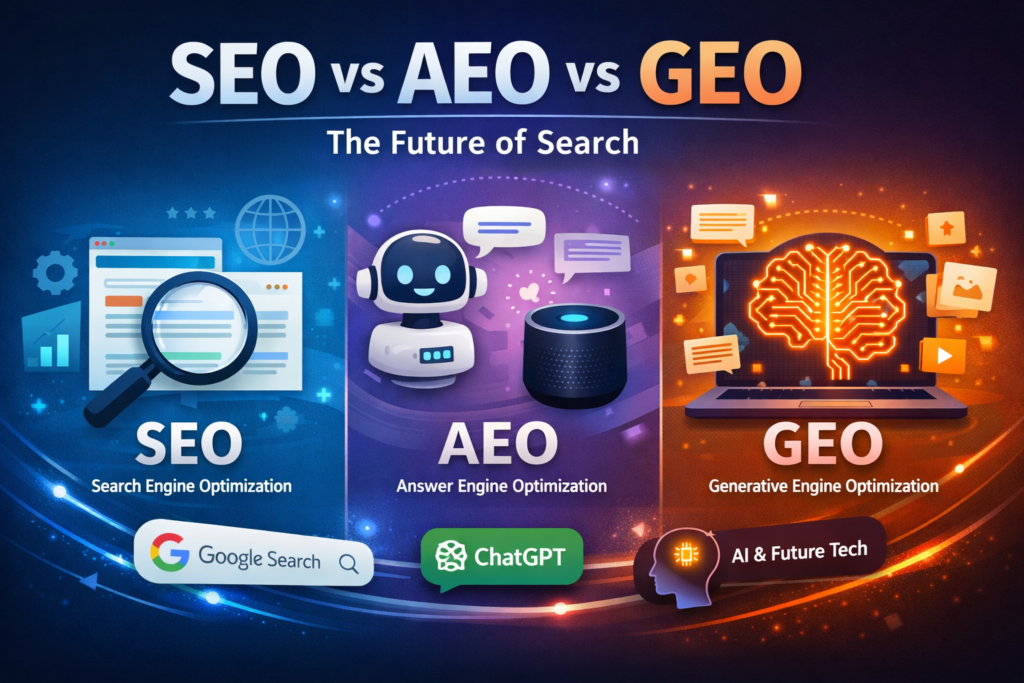
Key Differences Between SEO, AEO, and GEO
Factor SEO vs AEO vs GEO
Primary Goal Rank in search results Provide direct answers Influence AI-generated responses
Platform Search engines AI assistants and voice search Generative AI engines
Content Style Keyword optimized Question-based answers Comprehensive knowledge
User Interaction Users click links Users get answers instantly AI generates responses
These three strategies are not competitors — they complement each other.
Modern digital marketing requires integrating all three approaches.
⸻
Why the Future of Search Depends on All Three
Search behavior is evolving quickly.
Users now interact with information in multiple ways:
- Traditional search engines
- Voice assistants
- AI chat interfaces
- Generative AI research tools
Platforms like Google Search are also integrating AI-powered results and answer summaries.
This means businesses must optimize content for multiple discovery channels rather than relying only on traditional SEO.
A website optimized only for SEO may still rank on search engines but might not appear in AI-generated answers.
On the other hand, content optimized for AEO and GEO can appear in AI responses, featured snippets, and conversational search results.
⸻
How Businesses Can Adapt to the Future of Search
To stay competitive in the evolving digital ecosystem, businesses should adopt a hybrid strategy.
- Focus on Topic Authority
Instead of publishing random articles, create comprehensive content clusters around specific topics.
- Structure Content for Answers
Use clear headings, short paragraphs, and direct answers to common questions.
- Build Credibility
Include expert insights, statistics, and references to increase trustworthiness.
- Optimize for Conversational Search
People now ask complete questions rather than typing keywords.
Example:
Instead of searching “SEO tips,” users might ask:
“How can small businesses improve SEO in 2026?”
- Create High-Value Educational Content
AI systems prioritise content that genuinely helps users understand complex topics.
⸻
The Future of search: SEO vs AEO vs GEO
The future of search will not be dominated by a single technology.Instead, it will be shaped by the integration of search engines, AI assistants, and generative AI systems. This is not SEO vs AEO vs GEO, its SEO,AEO and GEO.
Traditional SEO will remain important for visibility on platforms like Google Search. However, Answer Engine Optimization and Generative Engine Optimization will play an increasingly critical role as AI-driven platforms become the primary way users discover information.
For businesses, marketers, and content creators, the message is clear:
optimizing for SEO alone is no longer enough.
Success in the future of digital marketing will depend on creating valuable, authoritative, and structured content that can be discovered by search engines, understood by AI systems, and delivered directly to users as trusted answers.
By combining SEO, AEO, and GEO strategies, brands can remain visible in the rapidly evolving landscape of AI-powered search.